# King Parikshit: The Emperor Who Chose Seven Days of Truth Over a Lifetime of Comfort
## King Parikshit
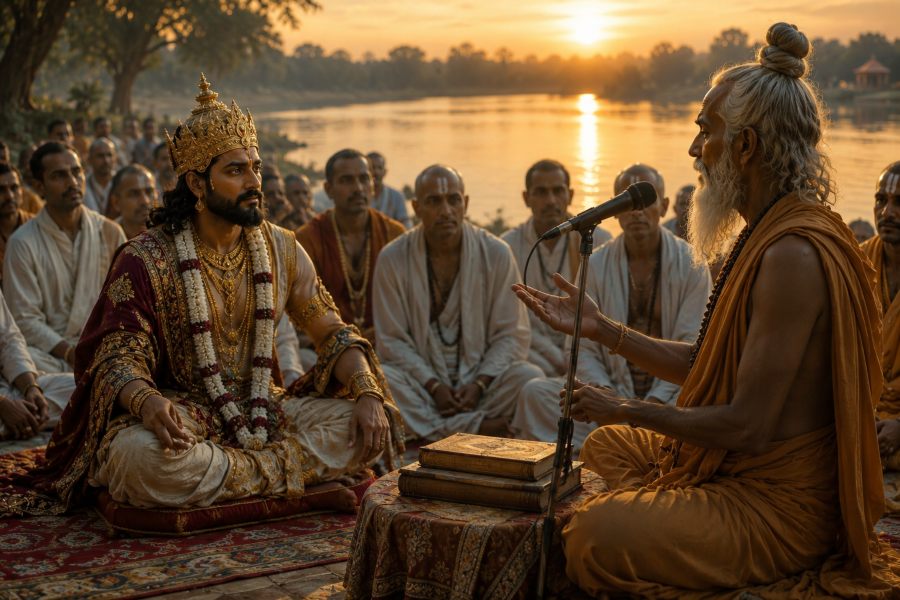
What would you do if you found out, right now, that you had exactly seven days left to live? Most people would panic, make frantic calls, try every doctor and every loophole to buy more time. King Parikshit did the opposite.
When a curse handed him a death sentence with a precise deadline, he didn't beg for more days. He sat down, called for the wisest teacher available, and asked one simple question: what should a dying man actually do with the time he has left? That question, and the answer he received, is the entire reason Srimad Bhagavatam exists in the form we read today, and it's still available in full through the [ISKCON Mayapur Store](https://mayapur.store/) for anyone who wants to sit with the same conversation Parikshit had 5,000 years ago.
### Who Was King Parikshit, Really?
Parikshit wasn't some minor royal figure. He was the grandson of Arjuna and the great-grandson of the Pandavas' entire lineage, which means he inherited a kingdom that had survived the Kurukshetra war, the political chaos after it, and the slow withdrawal of Krishna from the earthly plane.
There's a detail about his birth that most people skip past too fast. He was born after Ashwatthama launched the deadly Brahmastra weapon at Uttara, his mother, while he was still in the womb — an attack meant to wipe out the entire Pandava lineage. Krishna personally intervened, entering the womb to protect the unborn child. Parikshit survived an assassination attempt before he even took his first breath.
That's not a small detail. It shapes everything about who he became.
#### A King Who Ruled with Real Integrity
Once he took the throne, Parikshit ruled the way a Pandava descendant was expected to — fairly, according to dharma, protecting his subjects, and refusing to tolerate injustice even in symbolic form. This last part matters more than people realize.
There's a well-known episode where Parikshit encountered a bull and a cow being beaten by a personified figure of Kali (the age of quarrel, not the goddess). The bull represented religious principles, standing on only one leg instead of four, and the cow represented the earth, weeping and thin. Parikshit didn't ignore this. He confronted Kali directly, ready to execute him on the spot for tormenting these symbolic figures of dharma.
Kali begged for mercy, and Parikshit, still fair even toward his enemy, allowed him to stay in five specific places: gambling houses, wine shops, brothels, slaughterhouses, and wherever gold causes people to lie. This one decision explains why those particular activities still cause so much trouble in human society today — a detail devotees find oddly specific and eerily accurate even now.
### The Mistake That Changed Everything
Here's where the story takes its sharp turn, and it's worth being honest about what actually happened rather than softening it.
While out hunting, Parikshit grew thirsty and exhausted. He wandered into the ashram of a sage named Shamika, who happened to be deep in meditation and didn't respond when the king asked for water. Parikshit, tired and irritated, made an impulsive and disrespectful choice: he placed a dead snake around the sage's neck and left.
The sage's son, Shringi, heard about this insult to his father and reacted with fury. Without checking the full context or considering that his father hadn't been consciously ignoring the king, Shringi cursed Parikshit to die within seven days, bitten by a snake-bird named Takshaka.
When Shamika awoke and learned what his son had done, he was genuinely upset — he understood that Parikshit's mistake had been a lapse in judgment, not deliberate cruelty, and that a curse this severe was disproportionate. But a curse, once spoken with that kind of spiritual force, couldn't simply be withdrawn.
#### Why This Detail Actually Matters
Most retellings treat this as a minor plot device to get Parikshit to the Bhagavatam. That undersells it. This moment is genuinely uncomfortable because it shows a righteous king making an out-of-character error under stress and fatigue — something every person watching this story can recognize in themselves. Nobody is perfect all the time, not even a Pandava-blooded emperor known for his integrity.
The real test wasn't avoiding the mistake. It was how Parikshit responded once he learned the consequence.
### Seven Days Left — What Would You Do?
When the news reached him, Parikshit didn't argue, didn't send guards after Shringi, and didn't try to escape to some hidden location to dodge Takshaka. Instead, he made a decision that separates this story from almost every other death-sentence narrative in world literature.
He renounced his kingdom, handed the throne to his son Janamejaya, and traveled to the banks of the Ganges to fast and prepare for death consciously, surrounded by sages, rather than distracted by politics or fear.
This wasn't resignation. It was focus.
1. He didn't waste time trying to reverse the irreversible.
1. He didn't spend his final week chasing pleasure one last time.
1. He used the one resource he had left — his remaining attention — as efficiently as possible.
#### The Question That Started Srimad Bhagavatam
Sages from all over the world gathered around him once word spread that the Pandava descendant was preparing for death. Among them arrived Sukadeva Goswami, a young sage known for his complete detachment from worldly life, and Parikshit asked him a question that changed the shape of Vaishnava literature permanently
What is the duty of a person who knows they're about to die? What should someone hear, chant, remember, or do in their final moments to secure the best possible destination after death?
Sukadeva Goswami's answer to that question, delivered over the following seven days, became Srimad Bhagavatam itself — eighteen thousand verses covering cosmology, the pastimes of Krishna, the nature of the soul, and the path of devotion, all triggered by one dying king's honest question.
### Why Parikshit's Response Still Matters Today
Strip away the mythology for a second and look at the psychology here. Parikshit had every reason to spiral into fear, denial, or bargaining — the same stages most people go through when facing mortality. He skipped straight past all of that.
* He accepted the situation completely instead of fighting a battle he couldn't win.
* He prioritized clarity over comfort, choosing to fast and listen rather than indulge in his final days.
* He asked the right question instead of the obvious one — not "how do I survive," but "how do I make these last days count."
That third point is really the whole lesson. Most people, given a countdown, ask how to extend it. Parikshit asked how to use it properly. The difference between those two questions is the difference between fear-driven living and purpose-driven living.
### The Irony Nobody Talks About
Here's something worth sitting with: Parikshit's curse gave him exactly seven days, and in those seven days he received a scripture that has guided millions of people for thousands of years afterward. If Shringi's curse had never happened, Sukadeva Goswami might never have delivered this particular discourse in this particular form.
Sometimes the worst news a person receives ends up creating the conditions for something far more valuable than the thing they lost. Parikshit didn't get more time. He got better use of the time he had, and that turned out to matter more.
### What Parikshit's Own Name Reveals About Him
There's a small linguistic detail that adds another layer to this story, and it's one most casual readers never notice. The name "Parikshit" comes from a root meaning "one who examines" or "one who tests." According to tradition, he received this name because, as an infant, he was said to look around and examine everyone he encountered, searching — almost instinctively — for Krishna, whose form he had seen while still protected in the womb.
Think about what that means for the arc of his life. A child who spent his earliest days scanning faces for a glimpse of the Lord grew into a king who, at the very end of his life, spent his final seven days doing exactly the same thing — searching, through Sukadeva Goswami's words, for a deeper understanding of that same Lord. The examining infant and the questioning dying king are really the same person, just separated by decades and a throne.
This kind of symmetry doesn't happen by coincidence in the Bhagavatam's structure. Scripture built around real spiritual principles tends to circle back on itself this way, and Parikshit's story is one of the clearest examples of a life that begins and ends with the same underlying search.
#### The Weight of Being Arjuna's Grandson
It's easy to glide past the family pressure Parikshit carried simply by existing. He wasn't just any king — he was the last living link to the Pandavas in a world where Krishna had already begun his own withdrawal from the earth. Yudhishthira, Bhima, Arjuna, Nakula, and Sahadeva had all eventually departed for their final journey, leaving Parikshit as the sole administrator of an empire built by five extraordinary men and guided directly by Krishna himself.
That's an enormous inheritance to carry, and by most accounts, he carried it well for years before the incident with Shamika. His response to the curse, then, wasn't a one-time act of unusual maturity. It was consistent with a life spent trying to live up to a lineage that had personally witnessed the Lord's presence on earth.
### A Story About Time, Not Just Death
Strip away the specific details of curses and snake-birds, and what remains is a story about how differently people treat time depending on how much of it they think they have left.
* Someone who believes they have decades left often wastes hours without a second thought.
* Someone who believes they have one week left, like Parikshit, tends to ask sharper, more honest questions.
* The information available to both people is identical — nobody actually knows exactly how much time they have. Parikshit just happened to receive a specific number.
That's really the uncomfortable gift hidden inside this narrative. Most of us go through life assuming we have more time than we probably do, and that assumption quietly lowers the quality of the questions we ask ourselves. Parikshit didn't get to make that assumption, and it sharpened everything about how he spent his final days.
### Common Misunderstandings About Parikshit's Story
Because this narrative gets repeated so often, a few inaccuracies tend to slip in:
* He wasn't cursed for no reason. He genuinely committed a disrespectful act, even if it happened in a moment of exhaustion rather than malice. The story doesn't excuse his behavior; it shows redemption through his response afterward.
* The curse wasn't reversible, and he never asked for it to be reversed. Some retellings imply he searched for a cure or an escape. He didn't. He accepted the outcome and focused entirely on what he could still control.
* Takshaka's bite wasn't the climax of the story. The real climax is what happened in the seven days leading up to it — the conversation with Sukadeva Goswami, not the moment of death itself.
Getting these details right changes how the story lands. This isn't a tale about punishment. It's a tale about how a person facing the worst possible news can still choose to spend their remaining time with intention.
### Where the Full Story Comes From
Parikshit's entire narrative — his birth, his rule, the curse, and the seven days of discourse — appears across the First and later cantos of Srimad Bhagavatam, and reading Srila Prabhupada's purports alongside the verses reveals just how deliberately this framing device was constructed. The dying king isn't a side character. He's the reason the listener (meaning us) gets access to this knowledge at all.
If you want to go through Sukadeva Goswami's actual answer to Parikshit's question, the complete Srimad Bhagavatam sets are available through trusted Vaishnava publishers, giving you the full eighteen-thousand-verse conversation exactly as it was spoken on the banks of the Ganges, seven days before a king who chose truth over comfort met his end with open eyes.
Parikshit had seven days and a snake-bird waiting for him. What he chose to do with that time is the part of the story worth remembering.